Abstract
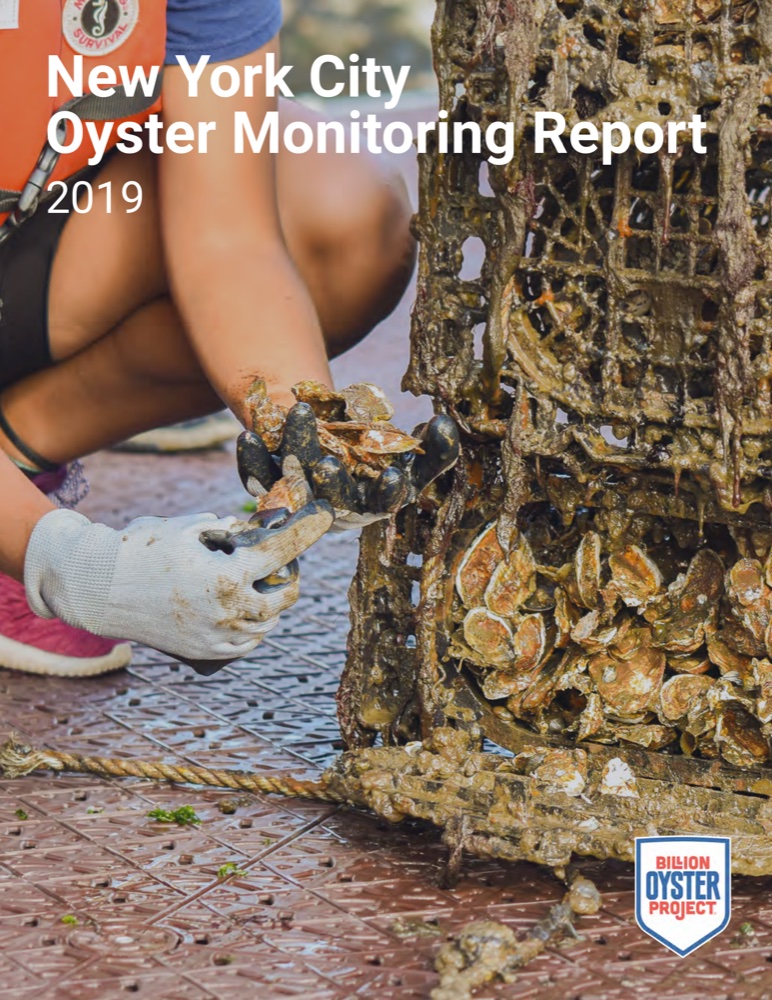
This project demonstrates the value of empirical pilot studies for designing full-scale oyster restoration. A pilot study involving deployment of oyster shell-filled gabions and two styles of Reef Balls found all substrates supported oyster recruitment and growth. For full-scale restoration, 422 modified gabions and 881 Mini-Bay style Reef Balls were deployed across three sites totaling approximately 2.4 ha (6 ac) in seafloor area. Both substrate types were heavily colonized by oysters and several other species. The final monitoring event in 2020 indicated a total of approximately 5.8 million live oysters on the substrates deployed in 2018 — the largest oyster habitat restoration project in or north of the New York Harbor region in recent decades.
Overview
A peer-reviewed paper in Restoration Ecology documenting what was, at the time of publication, the largest oyster habitat restoration project in or north of the New York Harbor region in recent decades. The project combined a careful pilot study with a genuinely scaled-up full deployment — a model for how urban restoration can move past one-off trials.
The pilot phase first tested shell-filled gabions and two styles of Reef Balls as candidate substrates. All three designs supported oyster recruitment and growth, which was the key threshold finding: each substrate was confirmed to work in the lower Hudson's specific conditions before full-scale capital was committed. That pilot-before-scale approach is rare in the field and expensive to skip.
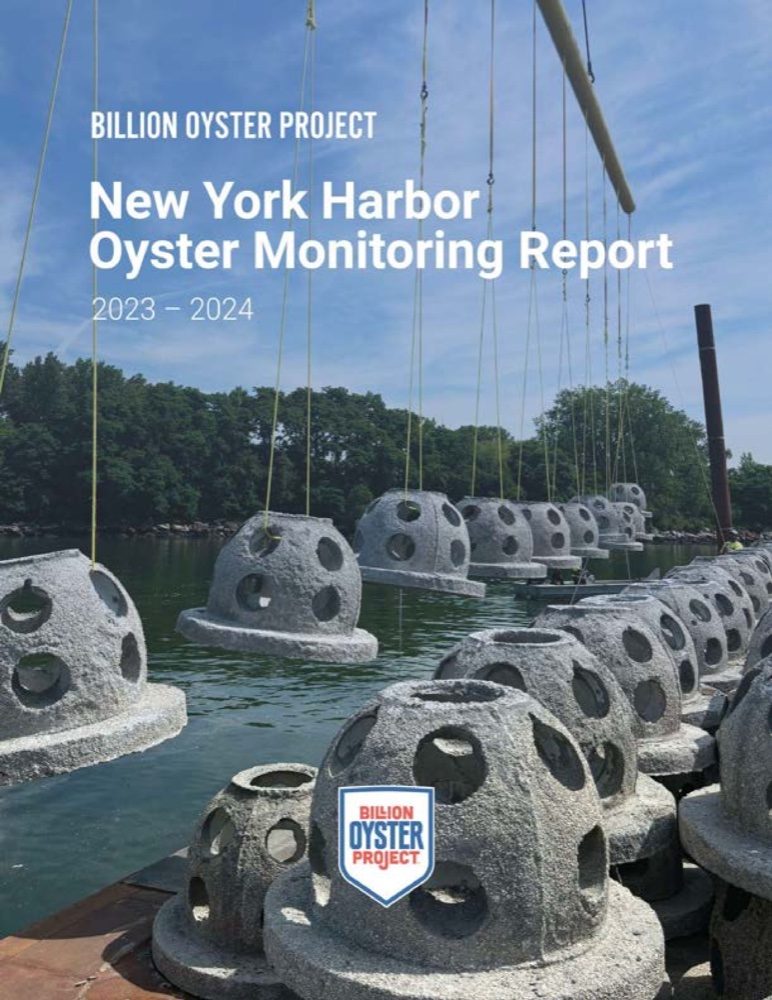
Results from the pilot guided full-scale deployment of 422 modified gabions and 881 Mini-Bay Reef Balls across three sites, totaling approximately 2.4 hectares (6 acres) of restored seafloor. At that footprint, the project is no longer a demonstration — it is a real, measurable addition of biogenic habitat to the lower Hudson, on the order required to produce ecosystem-level effects rather than just site-level ones.
Final monitoring in 2020 counted roughly 5.8 million live oysters on the installed substrates, along with heavy colonization by other species. The non-oyster colonization matters almost as much as the oyster counts — structurally complex habitat is what makes a reef a reef, ecologically. When other species move in, the installation has become ecosystem infrastructure, not just oyster infrastructure.
The paper is a proof point for an approach BOP has carried forward into its current strategy: empirical pilot work scaling cleanly into multi-acre, biologically active restoration. The 2023-2024 monitoring report's strategic shift toward landscape-scale reefs — retiring smaller experimental sites to concentrate resources — is directly informed by results like these, which show that scaled-up restoration in the region genuinely works when designed carefully.
Grizzle, R.E., Lodge, J., Ward, K., Mosher, K., Jacobs, F., Krebs, J. 2023. Successful initial restoration of oyster habitat in the lower Hudson River Estuary, United States. Restoration Ecology. DOI: 10.1111/rec.14077